
It’s my pleasure to welcome Point One as a quarterly sponsor of Weekly Robotics! Point One makes centimeter-level positioning practical for production robotics teams — combining the world’s densest, fully owned RTK corrections network with a sensor-fusion positioning engine and API, so you’re not building and maintaining your own base station infrastructure.
Another exciting update: we officially surpassed 6,000 e-mail newsletter subscribers! It’s been quite a journey, and I’m looking forward to seeing where it takes us.
Finally, if you are joining ICRA 2026 and want to touch base, feel free to reach out! I’ll be mostly at Foxglove’s booth and might carry some Weekly Robotics stickers. Enjoy today’s newsletter!




I Built Disney’s Star Wars Robot - YouTube
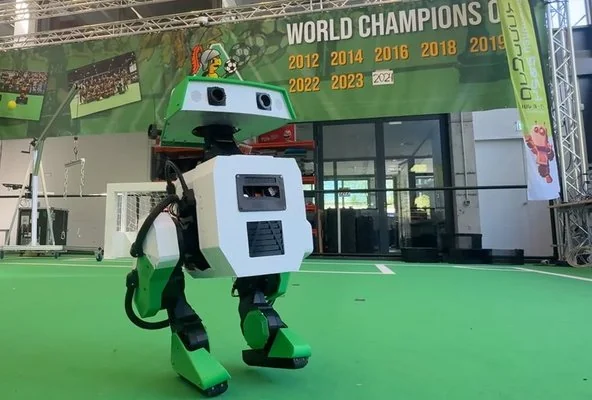
Kayden Knapik built his own version of the BD-X droid, which runs on Robstride servos, a Jetson Orin Nano, and a lawnmower battery (nice life hack!). Then, Kayden trained the robot to walk using Reinforcement Learning. Nice project!
Medium Access Control Protocols

Jason Fantl wrote a fantastic explainer on Medium Access Control protocols, starting from ALOHAnet and walking through Ethernet, WiFi, cellular networks, Bluetooth, Zigbee, LoRa, mesh networks, and VANETs. The article does a great job of explaining a deceptively simple question: what happens when multiple devices try to talk over the same medium at the same time?
I really enjoyed the progression from “send whenever you want and retry if it collides” in Pure ALOHA, through Ethernet’s collision detection, WiFi’s collision avoidance, and all the way to the much more complex scheduling and frequency/time/space allocation used in cellular systems. The sections on hidden nodes, stadium WiFi, and ad-hoc mesh networks are especially relevant for robotics, where robots often need to communicate in messy, dynamic, infrastructure-poor environments. This is a long read, but if you’ve ever had to debug unreliable wireless communication between robots, drones, sensors, or field devices, it’s well worth your time.
CoCo-InEKF: State Estimation with Learned Contact Covariances in Dynamic, Contact-Rich Scenarios

Since we are on the topic of Disney robots, check out this project from Disney Research:
This paper presents CoCo-InEKF, a differentiable Invariant Extended Kalman Filter that utilizes continuous contact velocity covariances instead of binary contact states. These learned covariances allow the method to dynamically modulate contact confidence, representing states ranging from firm contact to directional slippage or no contact. To predict these covariances for a set of predefined contact candidate points, we employ a lightweight neural network trained end-to-end using a state-error loss.
That’s a lot to take in, but the results speak for themselves - the robot state estimation looks top-notch!
Unitree GO-M8018-6 Motor Reverse Engineering

Thomas Flayols reverse-engineered the Unitree Go2 motors to enable writing custom firmware for them. For more information about this work, check out this GitHub repository.
ROS 2 Lyrical Luth Released! 🎉

A new ROS 2 distribution, Lyrical Luth, targeting Ubuntu 26.04 as a first-tier platform, has been released! Check out the changelog to see the new features that landed. It’s perhaps due to my work needs, but I’m going to find controlling rosbag records via services and Python very useful.
Three Ways to See Distance

Jaimin wrote an excellent summary of the state of the art of distance sensing currently used in robotics, including some state-of-the-art AI models for depth perception, all illustrated with nice XKCD-style graphics.
MARPY: a $50 micro-ROS robot

MARPY, short for Most Affordable ROS2 Platform Yet, is a $50 mobile robot based on the ESP-32 and micro-ROS. Check the project’s repository for more details.
Ultralightweight sonar plus AI lets tiny drones navigate like bats

Unfortunately, this article is very light on details, but I thought I would still highlight it in today’s issue. The team is using ultrasound for navigation on the drone, adding a ‘shield’ to block some of the noise from the propellers and running edge AI to further denoise the signal.
Our Sponsors
- Anyscale gives you a platform to run and scale all your ML and AI workloads, from data processing to training and inference.
- Foxglove is a purpose-built, modular platform for robotics teams to collect, organize, and learn from vast quantities of multimodal data, creating the data flywheel to safely scale from development to distributed fleets
- Jiga connects hardware teams directly with vetted manufacturers for reliable capacity from prototype to production, combining the speed of digital manufacturing with the trust of a long-term supplier relationship
- Point One Navigation delivers centimeter-accurate positioning to robots and autonomous systems — powered by the world’s densest fully-owned RTK corrections network.
Events
- Robotics Summit & Expo 2026: May 27 - May 28, 2026. Boston, Massachusetts, United States of America
- Actuate Global — Boston: Community Meetup: May 27, 2026. Boston, United States of America
- ICRA 2026: Jun 01 - Jun 05, 2026. Vienna, Austria
- ROS Meetup @ ICRA 2026: Jun 02, 2026. Vienna, Austria
- 2026 Energy Drone & Robotics Summit: Jun 22 - Jun 24, 2026. Houston, Texas, United States of America
- Robotics: Science and Systems: Jul 13 - Jul 16, 2026. Sydney, Australia
- Actuate 26: Aug 18 - Aug 19, 2026. San Francisco, California, United States of America
- Commercial UAV Expo: Sep 01 - Sep 03, 2026. Las Vegas, Nevada, United States of America
- Autonomy: Sep 14, 2026. Malmö, Sweden
- Open Source Summit: Oct 07 - Oct 09, 2026. Prague, Czechia
For more robotic events, check out our event page.
Want to promote your product or service in Weekly Robotics? Check out our advertising options.